
Case inserts: what’s inside
Basic educational kit: General, organic and inorganic chemistry
Basic chemistry practical kit for middle school and high school: about a hundred experiments in general, inorganic and organic chemistry in three cases.
Three cases contain laboratory chemical glassware, heating and measuring equipment, as well as models of molecules for practical work in chemistry in middle school and high school. One set provides about a hundred experiments - from separating mixtures, obtaining and recognizing gases to preparing solutions, qualitative analysis and assembling molecular models. The set is suitable for basic and advanced levels of study of the subject and meets the requirements for equipment for chemistry classrooms in general secondary education institutions according to the current curriculum.
- 1.Rod with internal thread Ø10×300 mm, M6 thread - 1 pc.
- 2.Rod with external thread Ø10×313 mm, M6 thread - 1 pc.
- 3.Laboratory clamp, max. clamp diameter 100 mm - 1 pc.
- 4.Laboratory stand ring with mount, small, outer diameter 62±5 mm - 1 pc.
- 5.bosshead clamp, M6 clamping screws - 2 pcs.
- 6.Laboratory stand base, detachable body, holes Ø10 mm - 1 set
- 7.Electronic laboratory scales 300 g, accuracy 0.01 g - 1 pc.
- 8.pH meter, range 0.00–14.00 - 1 pc.
- 9.Electronic thermometer, −50…+300 °C - 1 pc.
- 10.Multimeter - 1 pc.
- 11.Electrical conductivity tester, 0–999 ppm - 1 pc.
- 12.Magnet Ø8×60 mm - 1 pc.
- 13.Safety glasses - 1 pc.
- 14.Kit for assembling models of molecules (multi-colored balls with holes, flexible connections) - 1 set
- 15.Cuvette and holders for experiments with electrolysis - 1 set
- 16.Copper electrode - 1 pc.
- 17.Zinc electrode - 1 pc.
- 18.Steel electrode - 1 pc.
- 19.Graphite electrode - 2 pcs.
- 20.Laboratory test tube Ø20×200 mm - 7 pcs.
- 21.Glass rod 200 mm - 2 pcs.
- 22.Glass tube Ø8×200 mm - 2 pcs.
- 23.L-shaped tube Ø8×185×55 mm - 2 pcs.
- 24.L-shaped tube Ø8×85×55 mm - 2 pcs.
- 25.Glass tube Ø8×80 mm - 4 pcs.
- 26.Landolt vessel, neck Ø20 mm, two outlets - 1 pc.
- 27.Stopper 15/20/28, solid - 1 pc.
- 28.Stopper 15/20/28, with hole - 2 pcs.
- 29.Capillary tube 150 mm, hole Ø0.4 mm - 1 pc.
- 30.Capillary tube 150 mm, hole Ø0.6 mm - 1 pc.
- 31.Capillary tube 150 mm, hole Ø0.8 mm - 1 pc.
- 32.Capillary tube 150 mm, hole Ø1.2 mm - 1 pc.
- 33.Tube with a constriction, length 150 mm - 1 pc.
- 34.Spot plate, 6 wells for drop reactions - 1 pc.
- 35.Watch glass Ø60 mm, thickness 2 mm - 2 pcs.
- 36.Stopper 24/30/28, solid - 1 pc.
- 37.Stopper 24/30/28, with one hole - 2 pcs.
- 38.Stopper 24/30/28, with two holes - 1 pc.
- 39.Petri dish, base Ø90 mm, lid Ø98 mm - 1 pc.
- 40.Wash bottle 250 ml - 1 pc.
- 41.Graduated glass beaker 250 ml - 1 pc.
- 42.Round-bottom flask 100 ml, ground-glass joint 24/29 - 1 pc.
- 43.Laboratory funnel Ø60 mm - 1 pc.
- 44.Low crucible Ø81 mm - 1 pc.
- 45.Measuring cylinder 100 ml - 1 pc.
- 46.Ceramic pestle No. 2, 100 mm - 1 pc.
- 47.Mortar No. 2 ceramic, Ø70 mm - 1 pc.
- 48.Laboratory wire gauze 12.5×12.5 cm - 1 pc.
- 49.Filter paper Ø110 mm - 1 pack.
- 50.Graduated glass beaker 50 ml - 2 pcs.
- 51.Graduated glass beaker 100 ml - 1 pc.
- 52.Conical Erlenmeyer flask 100 ml - 1 pc.
- 53.Crystallising dish, 240 ml, with pouring spout, Ø90 mm - 1 pc.
- 54.Test tube rack, 19 cells - 1 pc.
- 55.Syringe 10 ml - 2 pcs.
- 56.Combustion spoon, bowl 2 cm, handle 19 cm - 1 pc.
- 57.Spatula-spoon 19.5 cm - 1 pc.
- 58.Test tube clamp for fixation Ø10–22 mm - 1 pc.
- 59.Graduated measuring beaker 250 ml - 1 pc.
- 60.Graduated measuring beaker 100 ml - 1 pc.
- 61.Tray 24.5×18.5±2 cm, plastic - 1 pc.
- 62.Silicone tube Ø9×Ø6 mm, 1 m - 1 pc.
- 63.Syringe 150 ml - 1 pc.
- 64.Test tube brush Ø22–25 mm - 1 pc.
- 65.Test tube brush Ø30–40 mm - 1 pc.
- 66.Dropper bottle 30 ml, glass - 2 pcs.
- 67.Straight steel tweezers 14 cm - 1 pc.
- 68.Pipette 10 cm, glass - 3 pcs.
- 69.Bottle for reagents 30 ml, glass - 2 pcs.
- 70.Alcohol lamp with adjustable flame height - 1 pc.
- 71.Laboratory crucible tongs - 1 pc.
- 1. Study of the physical characteristics of solids
- 2. Magnetic separation of solid heterogeneous mixtures
- 3. Safe use of laboratory equipment
- 4. Purification of table salt
- 5. Physical phenomena: melting ice and melting paraffin
- 6. Examples of chemical phenomena: calcination of copper wire and the reaction of chalk with hydrochloric acid
- 7. Construction of models of atoms and molecules
- 8. Decomposition of malachite — an example of the decomposition of a compound
- 9. Displacement reactions: the reaction of iron with copper(II) chloride solution
- 10. Introduction to oxides and study of their physical properties
- 11. Obtaining oxygen from potassium permanganate, its collection and study of properties
- 12. Effect of acids on acid-base indicators
- 13. Reactions of sulfuric acid with metal oxides
- 14. Hydrogen production and collection. Study of its properties
- 15. How temperature affects the solubility of solid salts in water
- 16. Preparation of a solution with a given mass fraction of salt
- 17. Interaction of acids with metals
- 18. Effect of alkalis on indicators
- 19. Preparation of insoluble bases
- 20. Interaction of insoluble bases with acids
- 21. Interaction between alkali and acid
- 22. Decomposition of copper(II) hydroxide when heated
- 23. Solving experimental problems on the topic “Main classes of inorganic compounds”
- 24. Interaction of zinc hydroxide with solutions of acids and alkalis
- 25. Testing substances for electrical conductivity
- 26. Strong and weak electrolytes
- 27. Ion exchange reactions in electrolyte solutions: CuSo₄ and alkali, Na₂CO₃ and HCl, neutralization of KOH and HCl
- 28. Solving experimental problems on the topic “Theory of electrolytic dissociation”
- 29. Recognition of chloride ions
- 30. Recognition of bromide ions, iodide ions, and iodine
- 31. Practical work. Obtaining hydrochloric acid and studying its properties
- 32. Detection of sulfate ions
- 33. Reaction of dilute sulfuric acid with zinc
- 34. Thermal decomposition of ammonium salts
- 35. Interaction of ammonium salts with alkali
- 36. Familiarization with the properties of phosphoric acid and its salts
- 37. Familiarization with samples of nitrogen and phosphorus fertilizers
- 38. Practical work. Obtaining ammonia, studying its properties
- 39. Qualitative test for carbonate ions
- 40. Practical work. Obtaining carbon dioxide and studying its properties
- 41. Practical work. Solving experimental problems on the topic “Non-metals”
- 42. Familiarization with samples of metals and alloys
- 43. Dependence of the rate of reaction of a metal with an acid on the nature of the metal
- 44. Flame coloring with metal salts
- 45. Interaction of metals with salt solutions
- 46. Familiarization with samples of aluminum and its alloys
- 47. Interaction of aluminum with acids and alkalis
- 48. Amphoteric properties of aluminum hydroxide
- 49. Qualitative tests for iron ions
- 50. Practical work. Water hardness and methods for eliminating it
- 51. Practical work. Solving experimental problems on the topic “Metals”
- 52. Qualitative detection of carbon, hydrogen and chlorine in organic compounds
- 53. Assembling models of hydrocarbon molecules and their derivatives
- 54. Study of the properties of liquid alkanes using hexane as an example
- 55. Obtaining ethylene and studying its properties
- 56. Detection of alkenes in cracked gasoline
- 57. Study of the properties of polyethylene, polypropylene and polystyrene
- 58. Preparation of acetylene and study of its properties
- 59. Study of the solubility of alcohols in water
- 60. Preparation of bromoethane from ethyl alcohol
- 61. Oxidation of ethanol with potassium dichromate
- 62. Study of the properties of glycerin
- 63. Study of the properties of phenol
- 64. Preparation of acetaldehyde by oxidation of ethanol with copper (II) oxide
- 65. Solubility of carboxylic acids in water
- 66. Preparation of acetic acid and study of its properties
- 67. Study of the properties of formic acid
- 68. Preparation of ethyl acetate and investigation of its properties
- 69. Preparation of esters (ethyl formate, isoamyl acetate)
- 70. Physical and chemical properties of fats
- 71. Saponification of fat, production of soap
- 72. Obtaining carboxylic acid from soap
- 73. Comparison of the properties of soap and synthetic detergent
- 74. Physical and chemical properties of glucose
- 75. Physical and chemical properties of sucrose
- 76. Physical and chemical properties of starch
- 77. Solving experimental problems “Oxygen-containing organic substances”
- 78. Properties of ammonia and methylamine solutions
- 79. Physical and chemical properties of aniline
- 80. Physical and chemical properties of amino acids
- 81. Physical and chemical properties of proteins
- 82. Study of the properties of plastics
- 83. Study of fiber properties
- 84. Thermal effects when dissolving salts in water
- 85. Thermal effects of acid–base neutralisation
- 86. Dependence of the rate of chemical reactions on various factors
- 87. Study of chemical equilibrium and influencing factors
- 88. Hydrolysis of salts
- 89. Redox reactions of various substances
- 90. Operation of a galvanic cell
- 91. Adsorption process on the surface of activated carbon
- 92. Ion exchange adsorption process
- 93. Colloidal solutions and their properties
- 94. Coagulation of sols
- 95. Properties of solutions of chlorine, bromine and iodine
- 96. Properties of sodium silicate
- 97. Properties of aluminum, its alloys and compounds
- 98. Properties of iron, its alloys and compounds
- 99. Properties of manganese and its alloys
- 100. Properties of chromium and its compounds
- 101. Corrosion of metals and methods of protection against it
- 102. Identification of inorganic substances
Middle school
basic level
Introductory chemistry concepts
- — Laboratory experiment 1. Signs of chemical reactions
- — Practical activity 1. Introduction to the chemical laboratory. Separation of mixtures
basic level
Oxygen
- — Laboratory experiment 2. Assembling simple devices for producing and collecting gases
- — Practical activity 2. Preparing oxygen and studying its properties
basic level
Hydrogen
- — Laboratory experiment 3. Effect of acids on indicators
- — Laboratory experiment 4. Reaction of sulfuric and hydrochloric acids with metals
- — Practical activity 3. Preparing hydrogen and studying its properties
basic level
Water
- — Laboratory experiment 5. The effect of alkalis on indicators
- — Practical activity 4. Neutralization reaction
basic level
Main properties of substances
- — Practical activity 1. Amount of substance
basic level
Main classes of inorganic compounds
- — Laboratory experiment 1. Preparation of an insoluble base
- — Laboratory experiment 2. Reaction of salt solutions with metals
- — Practical activity 2. Chemical properties of salts
basic level
The structure of the atom. Periodic law and periodic table of chemical elements
- — Laboratory experiment 3. Preparation of aluminum (zinc) hydroxide and study of its properties
- — Practical activity 3. Study of the acid-base properties of hydroxides of elements of the third period
basic level
Chemical bonding
- — Laboratory experiment 4. Building molecular models
- — Practical activity 4. Solving experimental problems
basic level
Review of the main topics in the grade VIII chemistry course
basic level
Solutions. Electrolytic dissociation theory
- — Practical activity 1. Preparation of a solution with a given mass fraction of solute
- — Practical activity 2. Ion exchange reactions between electrolyte solutions
basic level
Nonmetals
- — Laboratory experiment 1. Qualitative test for chloride ions
- — Laboratory experiment 2. Qualitative test for sulfate ions
- — Laboratory experiment 3. Qualitative test for ammonium ions
- — Laboratory experiment 4. Qualitative test for carbonate ions
- — Practical activity 3. Solving experimental problems on the topic “Non-metals”
basic level
Metals
- — Laboratory experiment 5. Qualitative tests for calcium and barium ions
- — Laboratory experiment 6. Preparation and oxidation of iron(II) hydroxide
- — Practical activity 4. Solving experimental problems on the topic “Metals”
High school
basic level
Hydrocarbons
- — Laboratory experiment 1. Making ball-and-stick models of hydrocarbon molecules
- — Practical activity 1. Preparing ethylene and studying its properties
basic level
Alcohols and phenols
- — Laboratory experiment 2. Oxidation of ethanol with copper(II) oxide
- — Laboratory experiment 3. Reaction of glycerol with copper(II) hydroxide
basic level
Aldehydes
- — Laboratory experiment 4. Oxidation of aldehyde with copper(II) hydroxide
basic level
Carboxylic acids
- — Practical activity 2. Comparison of the properties of carboxylic and inorganic acids
basic level
Esters. Fats
- — Laboratory experiment 5. Study of the properties of fats (solubility, evidence of the unsaturated nature of carboxylic acid residues)
basic level
Carbohydrates
- — Laboratory experiment 6. Reaction of glucose with copper(II) hydroxide
- — Laboratory experiment 7. Study of the physical properties of starch. Reaction of starch with iodine
- — Practical activity 3. Solving experimental problems
basic level
Nitrogen-containing organic compounds
- — Laboratory experiment 6. Properties of proteins: denaturation, color reactions
- — Practical activity 4. Solving experimental problems
basic level
Basic concepts and laws of chemistry
basic level
Chemical bonding and structure of matter
- — Laboratory experiment 1. Building molecular models of inorganic and organic compounds
basic level
Chemical reactions
- — Laboratory experiment 2. Study of the influence of temperature and acid concentration on the rate of reaction between zinc (iron) and hydrochloric acid
- — Practical activity 1. Chemical reactions
basic level
Chemistry of solutions
- — Laboratory experiment 3. Determination of the acidic or basic nature of a solution using indicators
- — Practical activity 2. Study of the properties of acids, bases and salts using the theory of electrolytic dissociation
basic level
Nonmetals
- — Laboratory experiment 4. Testing solutions of hydrogen compounds of non-metals with an indicator
- — Laboratory experiment 5. Study of the chemical properties of a dilute solution of sulfuric acid
- — Laboratory experiment 6. Detection of ammonium ions in solution
- — Practical activity 3. Solving experimental problems on the topic “Non-metals”
basic level
Metals
- — Laboratory experiment 7. Reaction of metals with acid solutions
- — Laboratory experiment 8. Detection of calcium ions in solution
- — Laboratory experiment 9. Amphoteric properties of aluminum and zinc hydroxides
- — Practical activity 4. Solving experimental problems on the topic “Metals”
advanced level
Hydrocarbons
- — Laboratory experiment 1. Making ball-and-stick models of hydrocarbon molecules
- — Practical activity 1. Preparing ethylene and studying its properties
advanced level
Alcohols and phenols
- — Laboratory experiment 2. Oxidation of ethanol with copper(II) oxide
- — Laboratory experiment 3. Reaction of glycerol with copper(II) hydroxide
advanced level
Aldehydes
- — Laboratory experiment 4. Oxidation of aldehyde with copper(II) hydroxide
advanced level
Carboxylic acids
- — Practical activity 2. Comparison of the properties of carboxylic and inorganic acids
advanced level
Esters. Fats
- — Laboratory experiment 5. Study of the properties of fats (solubility, evidence of the unsaturated nature of carboxylic acid residues)
- — Laboratory experiment 6. Comparison of the properties of soap and synthetic detergents
advanced level
Carbohydrates
- — Laboratory experiment 7. Reaction of glucose with copper(II) hydroxide
- — Laboratory experiment 8. Study of the physical properties of starch. Reaction of starch with iodine
- — Practical activity 3. Hydrolysis of starch
- — Practical activity 4. Solving experimental problems
advanced level
Nitrogen-containing organic compounds
- — Laboratory experiment 9. Properties of proteins: denaturation, color reactions
- — Practical activity 5. Solving experimental problems
advanced level
Review and consolidation of organic chemistry
- — Practical activity 6. Identification and study of the properties of plastics and fibers
advanced level
Basic concepts and laws of chemistry
advanced level
Chemical bonding and structure of matter
- — Laboratory experiment 1. Building molecular models of inorganic and organic compounds
advanced level
Chemical reactions
- — Laboratory experiment 2. Study of the influence of temperature and acid concentration on the rate of reaction between zinc (iron) and hydrochloric acid
- — Practical activity 1. Chemical reactions
advanced level
Chemistry of solutions
- — Laboratory experiment 3. Ion exchange reactions
- — Laboratory experiment 4. Determination of the acid-base nature of a solution using indicators
- — Laboratory experiment 5. Hydrolysis of salts (determination of pH of salt solutions)
- — Practical activity 2. Study of the properties of acids, bases and salts using the theory of electrolytic dissociation
- — Practical activity 3. Solving experimental problems on the topic “Chemistry of solutions”
advanced level
Nonmetals
- — Laboratory experiment 6. Testing solutions of hydrogen compounds of non-metals with an indicator
- — Laboratory experiment 7. Study of the chemical properties of a dilute solution of sulfuric acid
- — Laboratory experiment 8. Detection of ammonium ions in solution
- — Laboratory experiment 9. Detection of phosphate ions in solution
- — Practical activity 4. Solving experimental problems on the topic “Non-metals”
- — Practical activity 5. Identification of mineral fertilizers
advanced level
Metals
- — Laboratory experiment 10. Reaction of metals with acid solutions
- — Laboratory experiment 11. Detection of calcium ions in solution
- — Laboratory experiment 12. Amphoteric properties of aluminum and zinc hydroxides
- — Laboratory experiment 13. Detection of iron(II) and iron(III) ions in solutions
- — Practical activity 6. Solving experimental problems on the topic “Metals”
advanced level
Chemicals in everyday life and human activities
- — Practical activity 7. Solving experimental problems on the topic “Preparation and properties of inorganic compounds”
Other sets in the section "Chemistry»
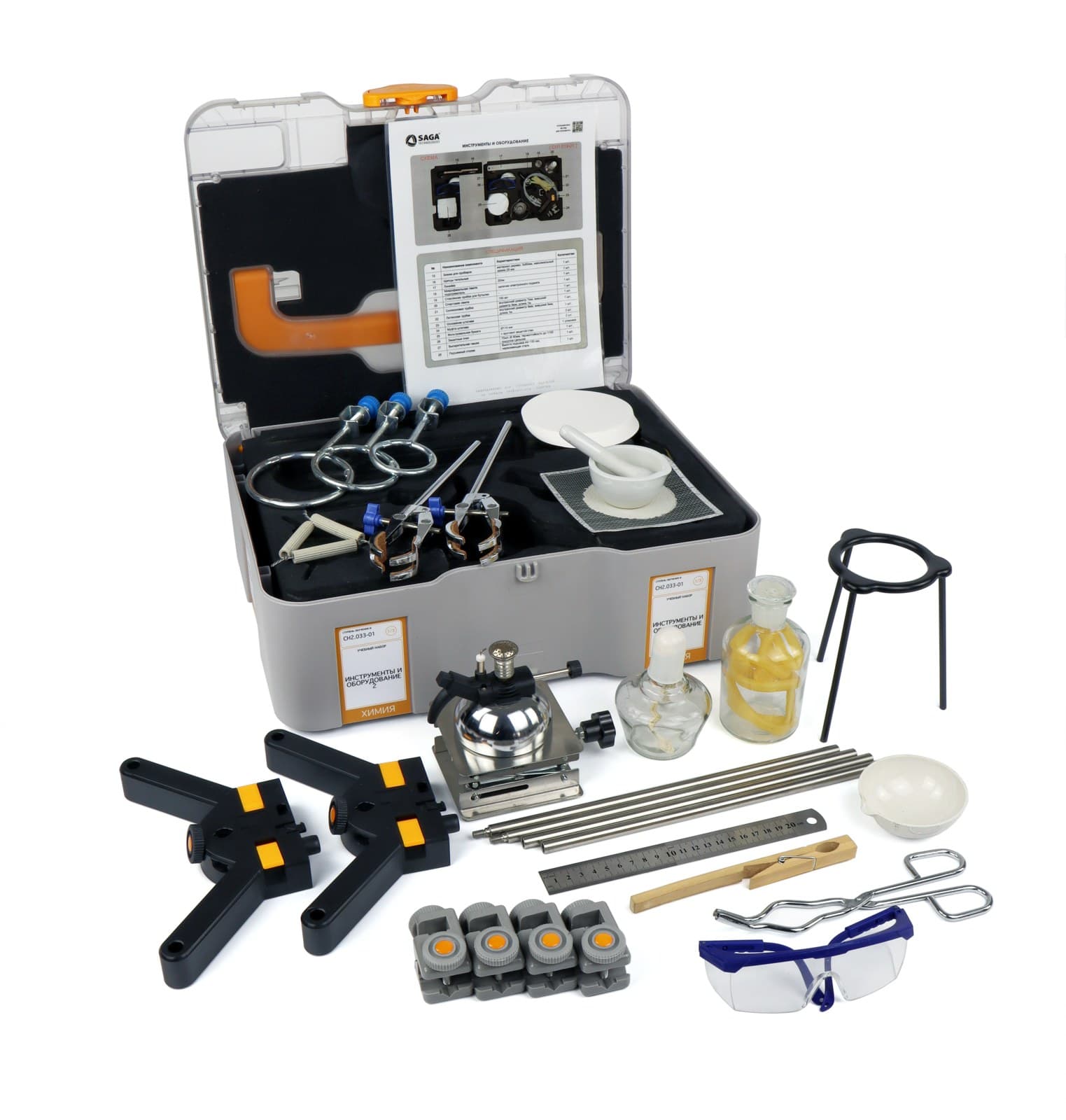
CH2.033
Educational kit: Chemistry tools and equipment, type 2
An expanded set of tools and equipment for chemistry: 94 items in three cases for basic and advanced laboratory work.
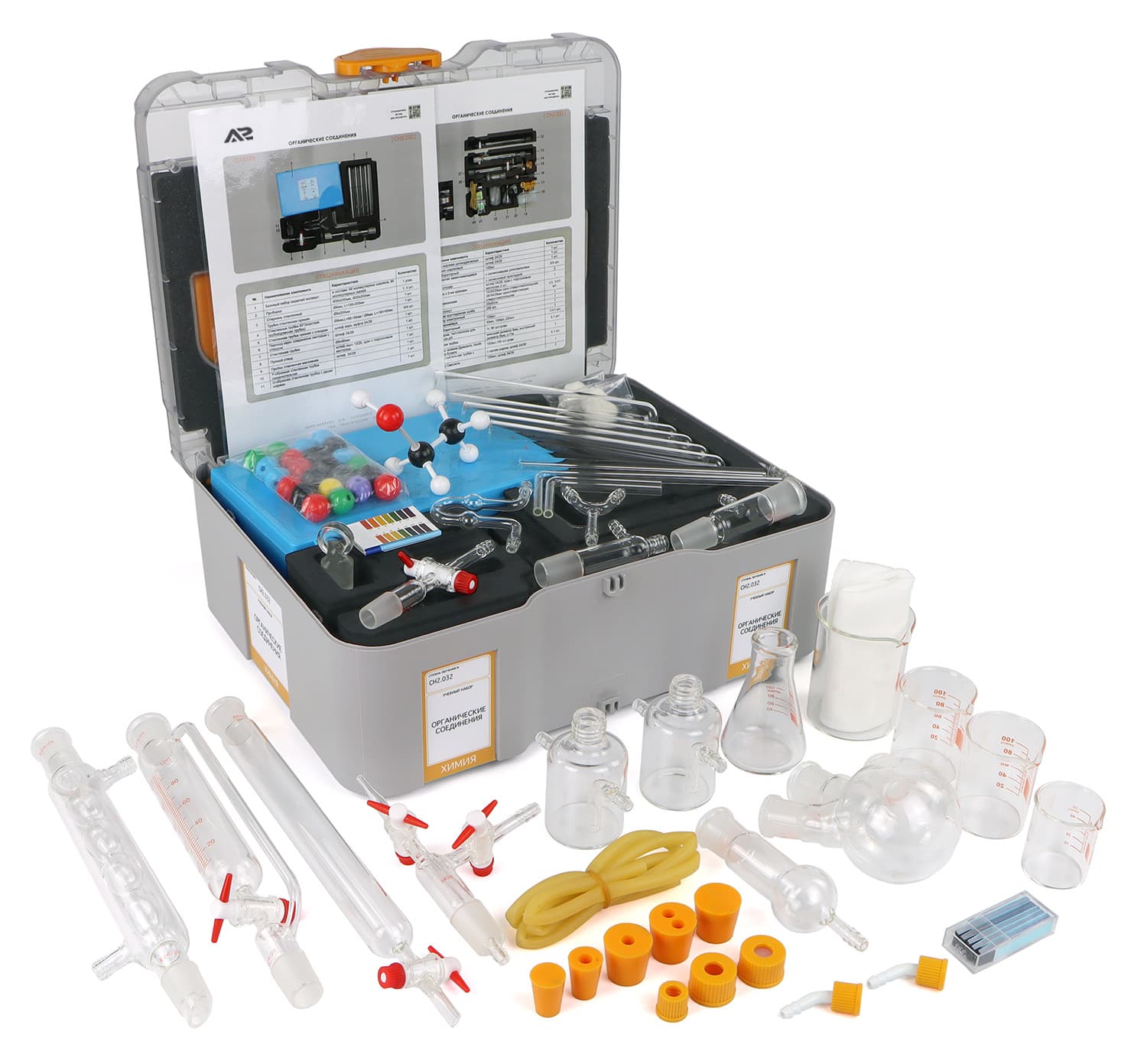
CH2.032
Educational kit: Organic compounds
Organic Compounds Set: 40 items for 14 organic chemistry activities - from alkanes and alcohols to carbohydrates and spectacular demonstrations.
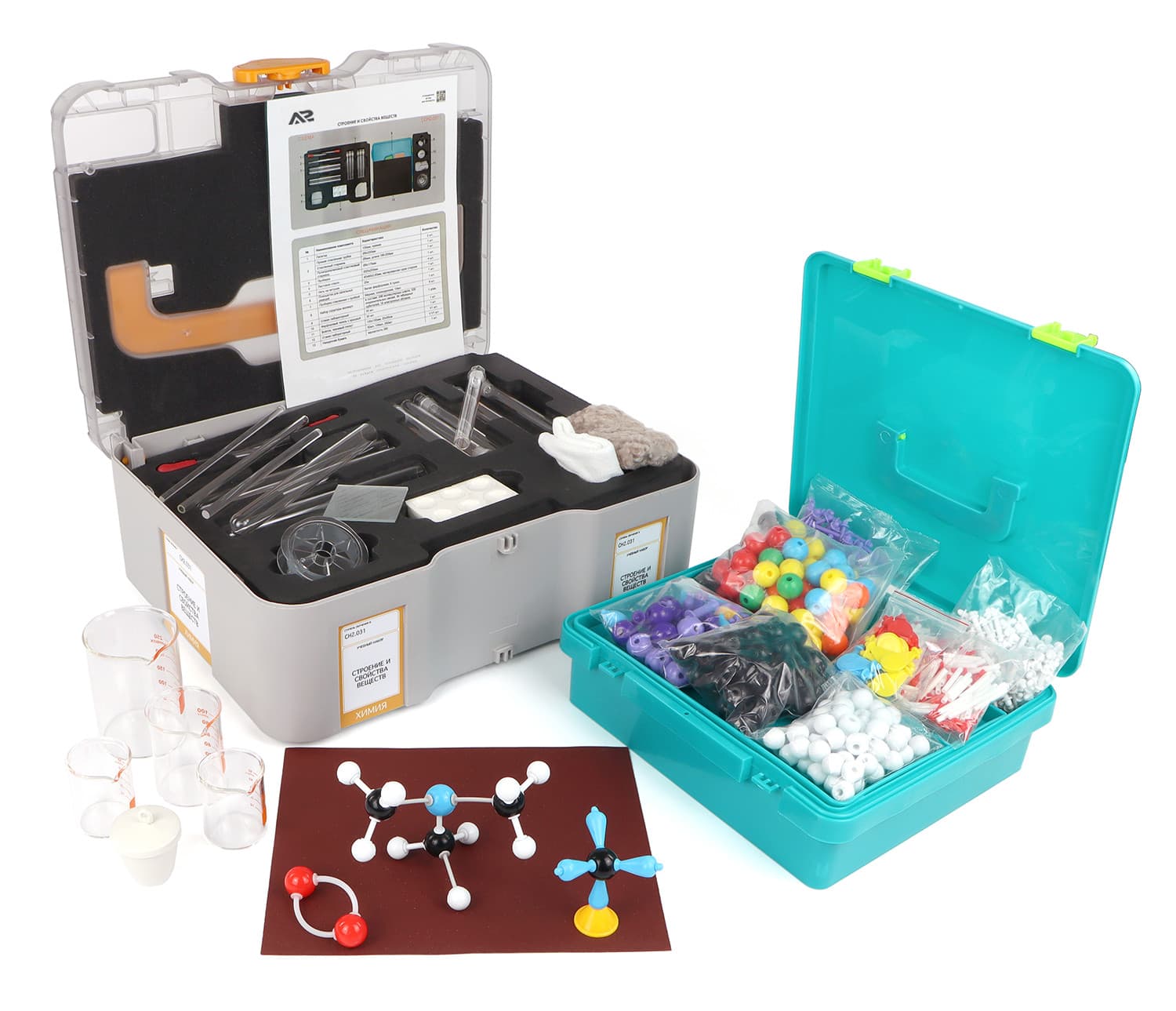
CH2.031
Educational kit: Structure and properties of substances
Set “Structure and properties of substances”: 17 items with a large model of molecules and electron clouds, 6 experiments on the relationship between structure and properties.
Looking for other equipment?
Tell us which equipment you need and the quantities. We can help you choose suitable items and prepare a quotation.