
Case inserts: what’s inside
Educational kit: Microscope and prepared slides
Educational kit with a light microscope and prepared slides for practical biology lessons.
The kit is designed for practical biology lessons using a light microscope and prepared slides. Students investigate the cellular structure of organisms, plant and animal tissues, microorganisms and anatomical features of different specimens, while developing microscopy skills and learning to interpret biological slides. The kit meets the equipment requirements for biology classrooms in general secondary education under the current curriculum.
- 1.Student laboratory microscope (three-position revolving nosepiece; 4×, 10× and 40× achromatic objectives; magnification 40×–1000×; adjustable transmitted and reflected LED illumination; mains power or 3 AA batteries; metal body) - 1 pc.
- 2.Eyepiece 10× - 1 pc.
- 3.Eyepiece 25× - 1 pc.
- 4.Smartphone mounting adapter - 1 pc.
- 5.Power adapter 220 V - 5 V / 0.5 A - 1 pc.
- 6.Dissecting needle - 1 pc.
- 7.Tweezers - 1 pc.
- 8.Scissors - 1 pc.
- 9.Knife (cutting tool) - 1 pc.
- 10.Pipette - 1 pc.
- 11.Glass slide 26×76×1 mm - 5 pcs.
- 12.Coverslip - 50 pcs.
- 13.Wipes - 5 pcs.
- 14.Set of 46 prepared microscope slides (general biology, zoology, anatomy and physiology, and general biological principles), in a plastic storage box for 50 slides - 1 set
- 15.Plastic storage case with fitted insert - 1 pc.
- 1. Structure and use of magnifying instruments
- 2. Observation of cotton fibres under a microscope
- 3. Microstructure of onion skin
- 4. Cell structure of Elodea leaf
- 5. Fruit cells containing chromoplasts
- 6. Geranium leaf epidermis and stomatal structure
- 7. External morphology of a young root
- 8. Morphology of shoots of trees and shrubs
- 9. Structure of leaf and flower buds
- 10. Meristematic tissue in the Elodea shoot apex
- 11. Microscopic structure of the stem
- 12. Movement of water and minerals in the stem
- 13. Morphological structure of the leaf
- 14. Microscopic structure of the leaf
- 15. Structure of a flower and inflorescences
- 16. Structure of the ovary of angiosperms
- 17. Anther structure
- 18. Seed structure and methods of seed dispersal
- 19. Structure of rye grain
- 20. Structure of the seed of a dicotyledonous plant
- 21. Determining the age of a tree from a trunk cross-section
- 22. The structure of Spirogyra
- 23. Reproduction of green mosses
- 24. Structure of a sphagnum leaf
- 25. Structure of the fern sorus
- 26. Structure of a fern prothallus
- 27. The structure of pine needles
- 28. The structure of pine pollen
- 29. The structure of a male pine cone
- 30. Structure of mucor II. ZOOLOGY
- 31. Structure of the Paramecium
- 32. Structure of green euglena
- 33. External structure of the hydra
- 34. Internal structure of the hydra (cross section)
- 35. External structure of an earthworm
- 36. Internal structure of an earthworm
- 37. The structure of daphnia
- 38. Structure of a Cyclops
- 39. External structure of a tick
- 40. External structure of an insect
- 41. The structure of the mouthparts of a mosquito
- 42. Structure of the mouthparts of a cockroach
- 43. Structure of the hind limb of a worker bee
- 44. Study of the structure of a chicken egg III. ANATOMY AND PHYSIOLOGY
- 45. Structure of an animal cell
- 46. Structure of epithelial tissue: simple epithelium
- 47. The structure of connective tissues. Hyaline cartilage
- 48. The structure of connective tissues. Bone tissue
- 49. The structure of connective tissues. Loose connective tissue
- 50. The structure of muscle tissue. Smooth muscle tissue
- 51. The structure of muscle tissue. Striated muscle tissue
- 52. Structure of nervous tissue
- 53. Structure of a nerve (cross section)
- 54. Structure of frog blood
- 55. Structure of human blood
- 56. Structure of animal germ cells (sperm)
- 57. Effect of saliva on starch
- 58. Effect of gastric juice on proteins. IV. GENERAL BIOLOGICAL PRINCIPLES
- 59. Structure of plant and animal cells
- 60. Mitosis in the root of an onion
- 61. Egg cleavage
- 62. Structure of Drosophila (normal and wingless form)
- 63. The breakdown of hydrogen peroxide in the cells of the Elodea leaf and raw potatoes
- 64. Plasmolysis and deplasmolysis in a plant cell
- 65. The entry of water and minerals into the cell
- 66. Movement of the cytoplasm in the cells of the Elodea leaf
- 67. Catalytic activity of enzymes in living tissues
- 68. Determination of the temperature threshold for coagulation of proteins in the cytoplasm of Elodea leaf cells
Middle school
basic level
Cellular structure of living organisms
- — Practical activity 1. The structure of plant and animal cells.
basic level
Protists
- — Laboratory activity 1. Structure of Paramecium.
- — Laboratory activity 2. Algal structure, using Spirogyra as an example.
basic level
Fungi. Lichens
- — Laboratory activity 3. Mould structure, examined using prepared microscope slides of Mucor (Penicillium).
basic level
General characteristics of plants
basic level
Spore-producing plants
- — Practical activity 1. Comparing spore-producing plants.
basic level
Gymnosperms
- — Practical activity 2. Comparing various types of gymnosperms (appearance, shoots, cones and seeds).
basic level
Vegetative organs of angiosperms
- — Laboratory activity 4. External structure of the seedling root.
- — Laboratory activity 5. External structure and identification of simple and compound leaves.
basic level
Flower. Fruit. Seed
- — Laboratory activity 6. How flower structure relates to its functions.
- — Laboratory activity 7. The structure of seeds of monocotyledonous and dicotyledonous plants.
basic level
Phylum Cnidaria
basic level
Phylum Annelida
basic level
Phylum Arthropoda
- — Laboratory activity 1. External structure of crayfish.
- — Practical activity 2. External structure of insects.
basic level
Human cells, tissues, organs and organ systems
- — Laboratory activity 1. Structure of tissues of the human body.
basic level
Internal environment of the body
- — Laboratory activity 3. Microscopic study of human and frog blood preparations.
High school
basic level
Chemical components of living organisms
- — Laboratory activity 1. Detection of catalase activity.
basic level
A cell is a structural and functional unit of living organisms
- — Laboratory activity 2. Mitosis in onion root cells.
- — Practical activity 2. Comparison of the structure of eukaryotic and prokaryotic cells.
basic level
Heredity and variability of organisms
advanced level
Structural organization of living organisms
- — Laboratory activity 1. The structure of the epidermis of a Tradescantia leaf.
- — Laboratory activity 2. Internal structure of the root (cross section).
- — Laboratory activity 3. Internal structure of the stem of a dicotyledonous plant (cross section).
- — Laboratory activity 4. Internal structure of the camellia leaf.
- — Laboratory activity 5. Tissues of the human body.
advanced level
Reproduction and individual development of organisms
- — Laboratory activity 8. The structure of animal germ cells.
advanced level
Chemical components of living organisms
- — Laboratory activity 1. Detection of catalase activity.
advanced level
A cell is a structural and functional unit of living organisms
- — Laboratory activity 2. Study of the phenomenon of plasmolysis and deplasmolysis in the epidermal cells of the onion bulb.
- — Laboratory activity 3. Mitosis in onion root cells.
- — Practical activity 2. Comparison of the cell structure of prokaryotes and eukaryotes.
advanced level
Heredity and variability of organisms
Other sets in the section "Biology»
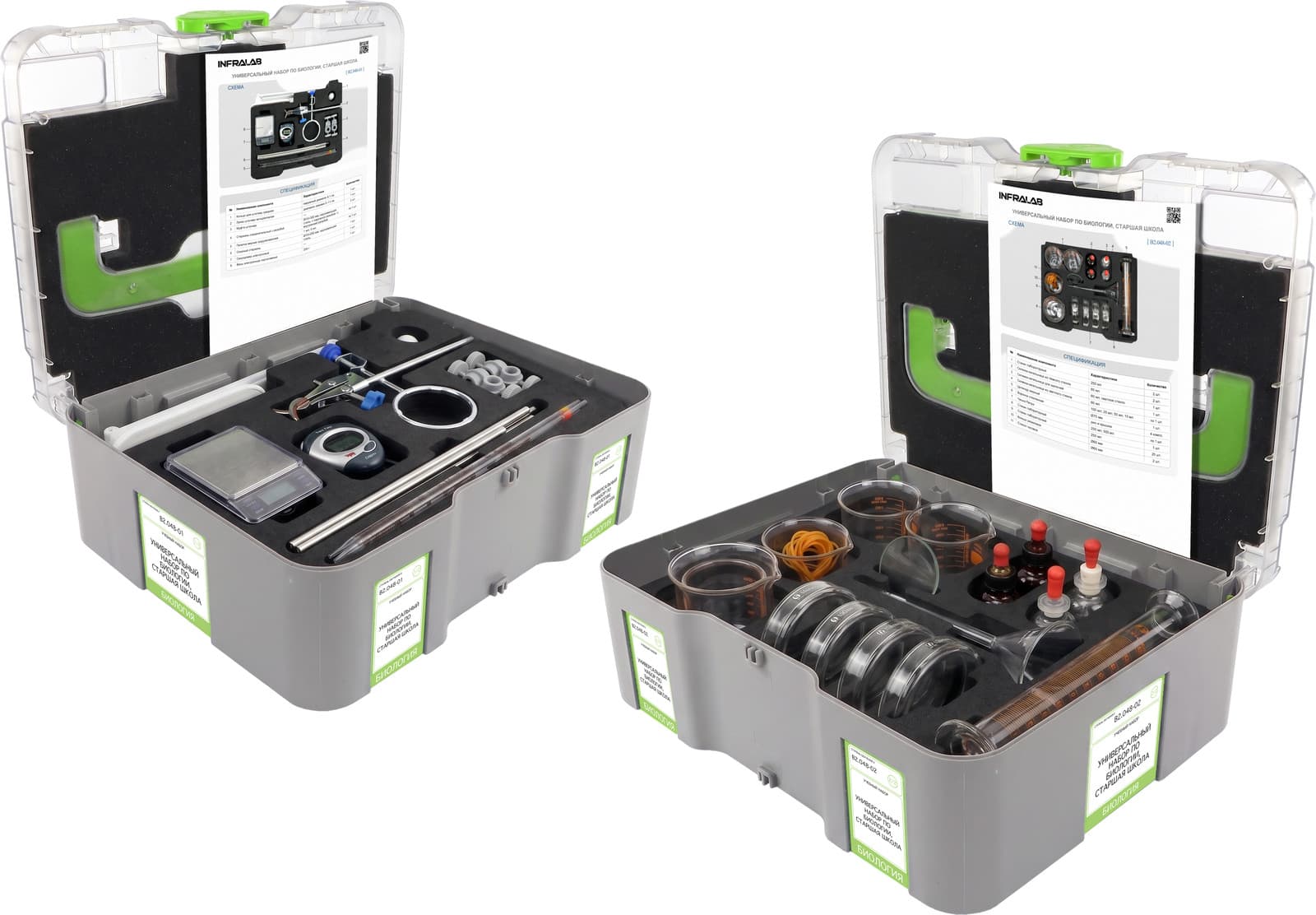
B2.048
Educational kit: General biology, upper secondary school
A universal set of laboratory ware, tools and equipment for the biology classroom in high school: 35 items in two cases, the basis for topic-specific sets.
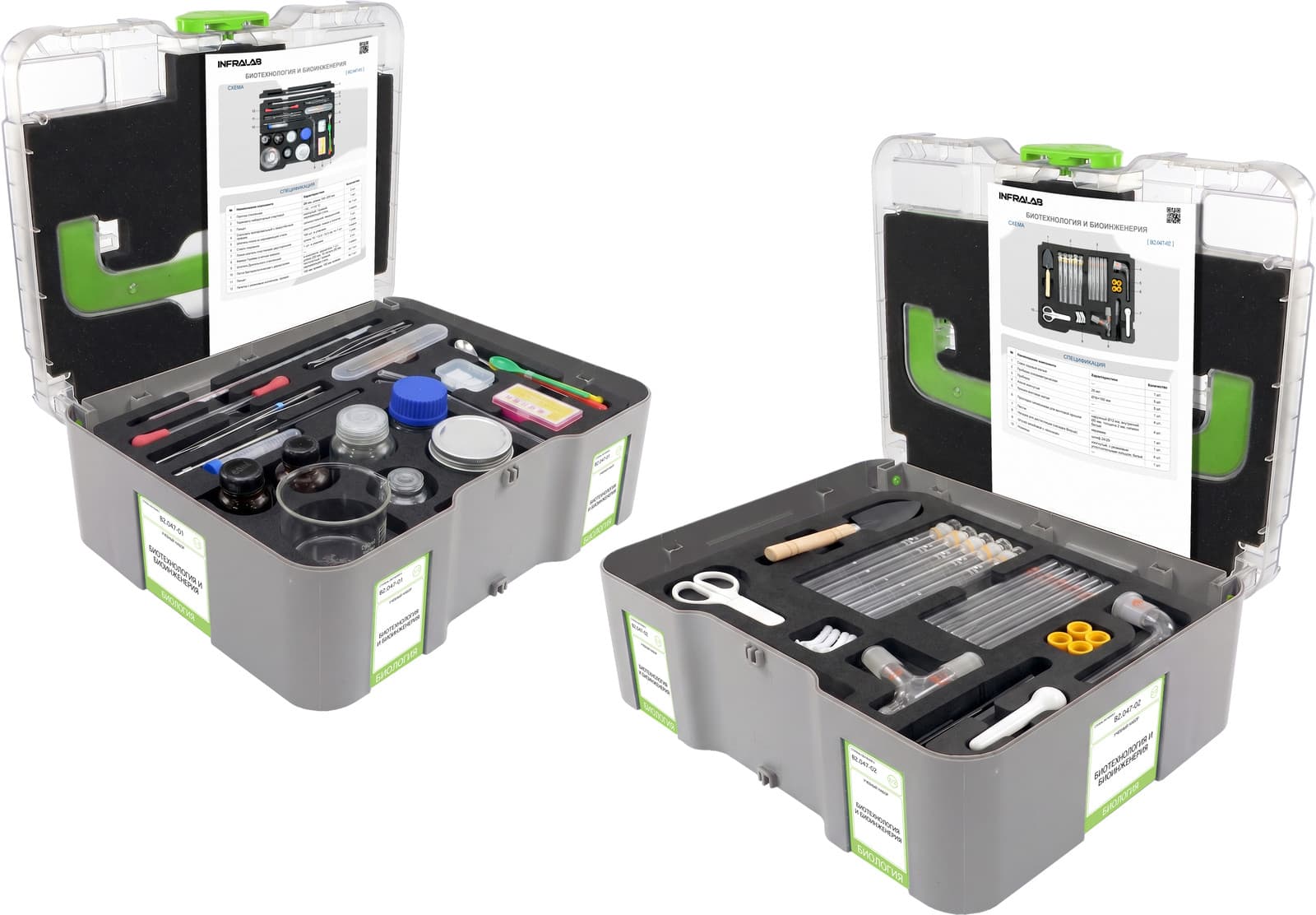
B2.047
Educational kit: Biotechnology and bioengineering
Laboratory set “Biotechnology and Bioengineering” for biology high school: 53 equipment items in two cases, 17 laboratory activities.
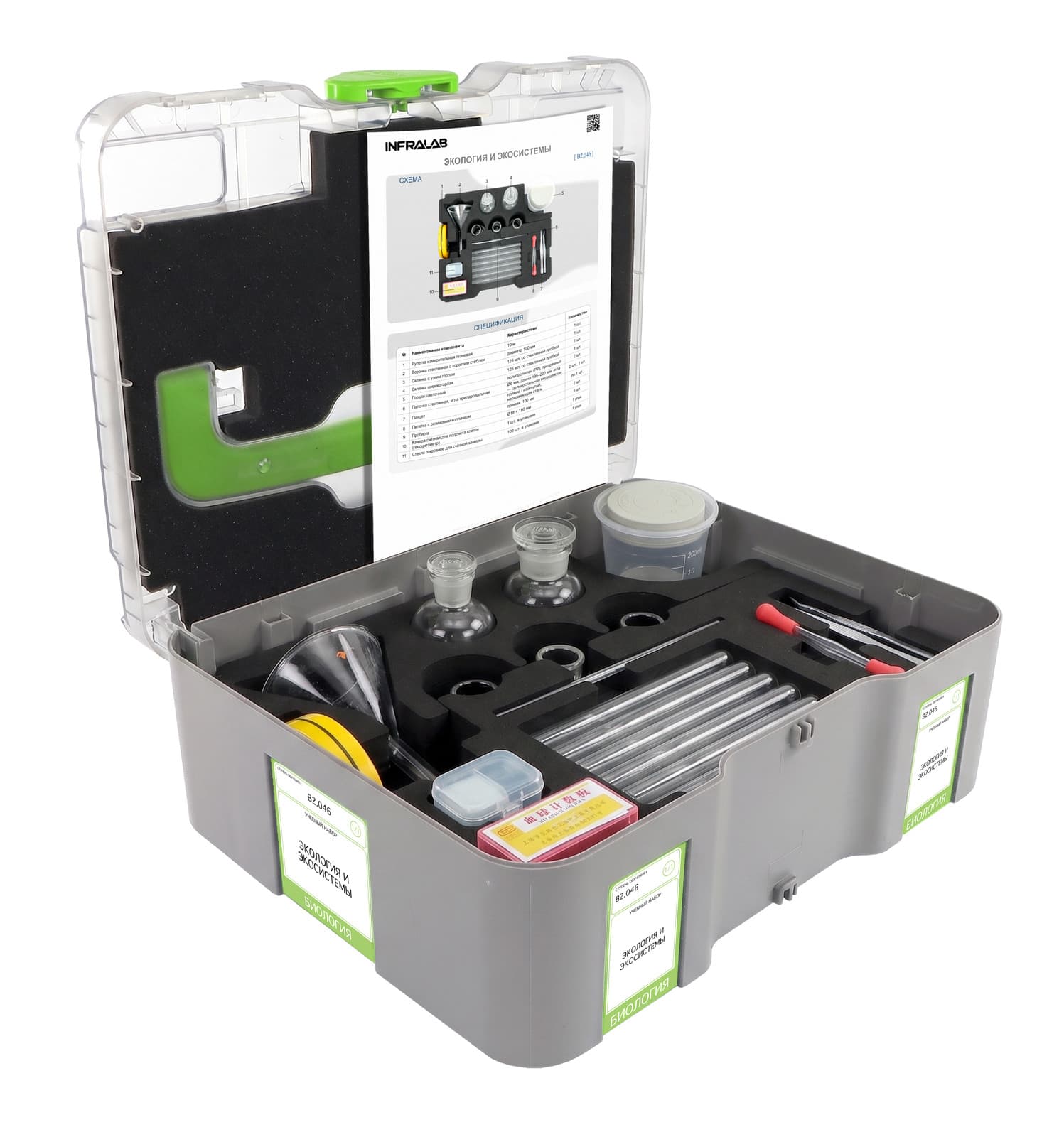
B2.046
Educational kit: Ecology and ecosystems
Laboratory set “Ecology and Ecosystems” for biology high school: 23 equipment items in a case, 5 laboratory activities.
Looking for other equipment?
Tell us which equipment you need and the quantities. We can help you choose suitable items and prepare a quotation.